



 When in-house tax professionals encounter uncertainty, it’s important to remember that their companies are facing the same turbulence.
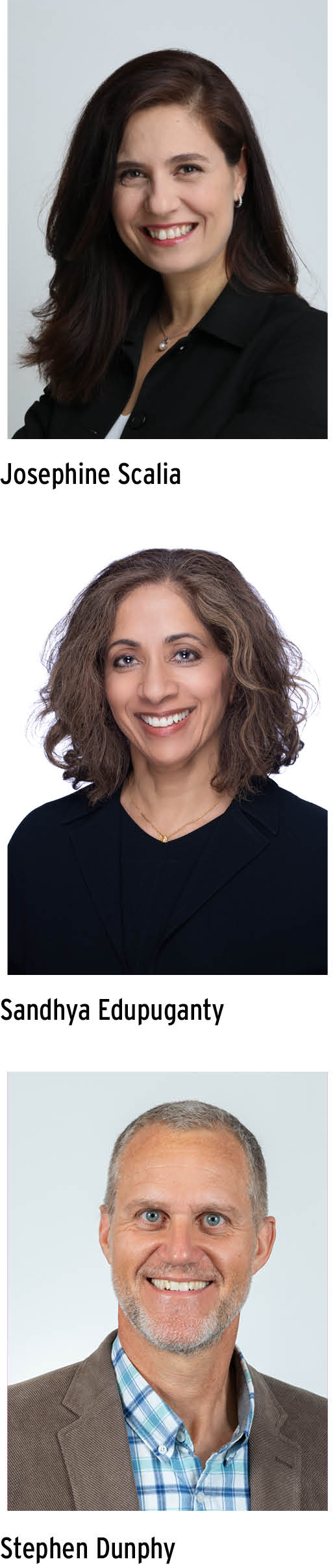
“Certainty is something we can never truly have, so for me it’s more about gaining clarity and focusing on what is within our control, amid all the uncontrollable,” says Josephine Scalia, vice president and head of global tax at CAE and TEI’s immediate past international president.
Although uncertainty is a given in tax, today’s national and international circumstances inject new levels of unpredictability. It’s a time to buckle down on the fundamentals, remaining committed to transparency and integrity, while taking a strategic approach to leveraging the efficiencies of technology.
Effective Management Strategies
Fortunately for in-house tax professionals, change is enticing. “Part of the reason I enjoy tax is because of the constant change,” says Sandhya Edupuganty, vice president of tax at Sabre Corporation. “Things are always changing and evolving. There’s a lot of opportunity to empower the business. How do we partner with the business to assist them in making strategic tax decisions and strategic business decisions that are tax favorable? How are we proactive versus reactive?”
A disciplined approach assesses risk, gathers intelligence across functions, and finds gaps to be addressed, Scalia says. “It doesn’t get easier, but you get better at it,” she says. “First and foremost, you need to be comfortable with being uncomfortable. That’s the mindset of becoming a change agent. Clarity grows when we stay curious and when we have the courage to dig deeper. When something feels off, that’s your signal to lean in, ask more questions, and gather more information so you can gain the insight you need to move forward.”
Stephen Dunphy, senior vice president of tax at Ross Stores and Institute secretary, cites the example of retroactive tax benefits as a case for budgeting conservatively and basing forecasts on the facts at hand. “We certainly want the tax incentives, but it is difficult to shape business behavior if they are retroactive,” he says. “We definitely want retroactive tax benefits, but we’re not counting on them because they’re not in law, and so we account for only what has been enacted.”
In an atmosphere where one speech, social media post, or Supreme Court ruling can send markets skyrocketing or spiraling, tax leaders should always have options and stock their toolboxes with planning ideas for use at any moment, Dunphy notes. “These days are much more fluid than they used to be with information flows and market availability,” he says. “You’re listening to a speech, and, all of a sudden, everyone has built it into the market, but who knows if it’s going to be actually in a law?”
Rich in Resources
Available resources for keeping pace with changing conditions include financial media, publications, and daily tax updates, Dunphy says. They also include conferences programmed by TEI and other professional associations, where tax professionals can learn tactics and actionable items to take back to the office.
TEI’s Tax Leadership Academy offers training and simulations in leading through change, communications, and negotiations—building capabilities to navigate uncertainty, Scalia says. TEI is a reliable source of intel, including benchmarks and comparables, with key data to help make informed decisions, she adds.
And, of course, there is the networking that helps tax professionals get advice from a diverse set of peers who have faced and resolved similar issues. “That’s where you find your tax friends,” Scalia says. “We all help each other, and it’s incredibly practical. We are all facing similar challenges, and it’s so valuable to be able to connect with a trusted community of like-minded people.”
As Edupuganty notes, “you’re not disclosing anything of a confidential nature, but it’s just sharing of opportunities, pitfalls, and roadblocks. You learn from others’ good and bad experiences.”
Technology for Efficiency
Adapting to a changing world includes taking stock of rapid developments in technology, says Edupuganty, a veteran of leading technology transformations. “I need to understand what technology is out there,” she says. “Look at the iPhone and everything that we expect from our handhelds. We expect this much from what we use, so why shouldn’t the same be expected of us as a tax function?”
Technology can deliver the efficiency to streamline what she calls the “number one priority” for tax professionals in public companies—accurate quarterly and annual effective tax rates that can be difficult to compile, given overlapping timelines, but that financial statement auditors check regularly. “It’s a matter of balancing and engaging,” she says. “If I’m part of a team, I want to feel like I’m really adding value versus crunching numbers. The tax technical capability is a starting point.”
Tax offices should pursue process improvements, removing roadblocks and scrutinizing technology for its power—within budget constraints—to create efficiencies. “I tell my team, if you put technology on top of a bad process, you get a bad answer faster,” Edupuganty says. “It’s my responsibility to put things in place where we can be more efficient and deliver the same, sometimes better, results.”
Focusing on data quality and unifying fragmented systems ensures that technology is delivering operational efficiencies with accuracy, Scalia says. Ultimately, gaining advantages comes down to creating automated systems that are easy to understand. “You could have an amazing system to roll out, but if only a small group can operate it, you’ve created dependency instead of resilience,” she says.
The emergence of AI streamlines time-consuming, repetitive manual tasks, such as applying the appropriate tax treatment to each sale, and it simplifies tax research by mining for useful information and delivering it quickly, Dunphy says. “It’s a question of just trying to decide where you can make best use of this to minimize your time and maximize the benefit and still be mindful of the budget you’re allocated,” he says. “I can’t go and justify spending on something that won’t actually generate ultimate savings. A lot of it goes back to the feasibility analysis and studying the potential outcome. How much does it cost? How much are you going to ultimately gain? Map it out and justify your business case.”
Managing Budgets
With the resources they have at hand, tax executives need to know how to prioritize tasks, seek outside help, and advocate for adequate resources in plain language, Edupuganty says. “Something might be thirty steps long, so it’s not always easy to communicate that, but you can always back into the detail,” she says. “If you start with the detail, you’re going to lose your audience.”
Barring sudden growth spurts in the enterprise, in-house tax leaders rarely get to argue for higher headcounts in their offices, “so then it becomes a matter of how you become more efficient with the headcount that you have,” Edupuganty says. “Are we operating in the areas that matter?”
Even amid “some level of prudence in how you operate,” she adds, there are chances to explore opportunities and rethink old tactics. “Do we need to do everything the same as we’ve been doing the last twenty years? No,” she says. “What is changing around us that’s going to take up our attention?”
Scalia starts by taking inventory of her resources, to know at a glance the scope, legal entities, revenue, and processes inherent in the corporate tax functions. “Who’s working on what, and how long should it take?” she says. “It’s really important to have a good pulse and to check it constantly, because things are changing so fast.”
Hiring interns stretches office resources and supports processes not only by providing help on specific tasks but also by giving junior staff experience in managing and delegating, Scalia says. “It makes them see their own mistakes and then develop their own best practice. It makes them better employees, because then they’re teaching, and once you can teach it to someone, suddenly you really understand how it works,” she says.
Building Talent Pools
Industries worldwide are struggling to find and retain top talent, but in-house tax professionals are applying their usual ingenuity and creativity to the problem.
Edupuganty hired three new people in 2025, finding strong candidates by emphasizing that team members have agency to ask for what they need when they need it. “If you’re not getting what we need, come to me, and we’ll figure out how to address this,” she tells them. “But you have agency. Show initiative. There’s a lot of opportunity here.”
Scalia, who has a passion for mentoring and growing talent, led TEI in launching the TEI International Tax Student Case Competition, which is coming up on its fourth annual event this August. Fewer people are studying to be certified public accountants, and the case competition helps to “break down the myths about what it is to be a tax person,” she says.
Holding the competition for college students introduces young people to careers as in-house tax executives, which, many have told Scalia, they hadn’t thought about. Although tax knowledge is essential, tax professionals deal with C-suite leaders and board members who aren’t interested in the codehead side of taxation, so the competition simulates the roles of in-house tax professionals while connecting students with mentors “who can explain what it’s really like,” Scalia notes.
International and Domestic Tax
As domestic and international issues surge, in-house tax professionals navigate them by staying informed, using all available resources, and keeping the company’s interests in the foreground.
The fluid Organisation for Economic Co-operation and Development’s Global Anti-Base Erosion Model Rules, also known as Pillar Two, are an example. In tandem with empowering countries to tax companies for their digital as well as their physical presences, Pillar Two allows each participating country to collect a minimum tax. That minimum, seen as unfair to US companies, was amended by the G7’s “side-by-side system” exempting US-parented multinationals, but uncertainty has been a hallmark of the process.
“The concern there is that it’s very disruptive,” Edupuganty says. “If you’re a public company, you have to report your information based on everything that’s enacted, that’s in place. If I don’t do it in a timely manner and the difference is large enough, that leads to financial statement issues that management becomes aware of, that the audit committee becomes aware of, that potentially shareholders could become aware of. It’s a financial, political, and reputational nightmare that you want to avoid, so it’s your responsibility to be hawkish on knowing what’s going on everywhere.”
Dunphy found himself advising his leadership on the nuances of the 2025 One Big Beautiful Bill Act’s 100 percent bonus depreciation for certain qualified property. “That definitely helped companies from a cash tax perspective, and that’s important,” he says. “Does it help the tax expense? It depends. Does it help cash taxes? By how much? What are the tax reporting considerations that we need to be aware of?”
Some countries also require enterprises to hand over their books to determine tax owed. The transfer process requires close collaboration with IT teams, Edupuganty says. “How do you accommodate it and the timeline for accommodating it?” she asks. “You don’t have a choice because otherwise you potentially could be banned from operating in the country.”
Dunphy emphasizes the importance of tapping industry member organizations, such as TEI, for information and help in shaping sound tax policies that affect business competitiveness, including the potential reinstatement of the vital Work Opportunity Tax Credit and the rules for accurately valuing goods impacted by ever-changing tariffs.
Trusted Relationships
In-house tax professionals agree: building rapport with leadership is essential for navigating uncertainty—and it can’t begin when challenges arise.
“If you’ve built strong relationships, support follows,” Scalia says. “Good communication makes all the difference.”
And, she adds, attention to relationships also helps tax professionals build internal networks of trusted colleagues who, recognizing tax leadership’s pivotal role in safeguarding the company, step up to provide timely insight and support.
Transparency retains trust with the leaders who serve as champions and advocates for their tax departments, Edupuganty says. Nobody likes surprises, she says, “so as soon as I become aware of something, I want to mention it to them, because it’s my responsibility to the organization. None of this is mine. It belongs to the company. So, how am I being a good steward of the company?”
Diane McCormick is a Pennsylvania-based freelance journalist.