



The One Big Beautiful Bill Act (OBBBA) has added a new set of restrictions to the federal clean energy tax credit regime, known collectively as the foreign entity of concern (FEOC) framework. A FEOC, in broad terms, is an entity owned by, controlled by, or subject to the jurisdiction or direction of the government of a covered nation: China, Russia, Iran, or North Korea.. For the first time, credit eligibility now turns on the ownership, governance, and supply chain relationships of the parties claiming or supporting the credits. The prohibited foreign entity (PFE) rules and the related material assistance limitations have become the most consequential new compliance gating items in the clean energy tax credit market. Internal Revenue Service Notice 2026-15, released February 12, 2026, provides the first formal interpretive guidance. It operationalizes the material assistance cost ratio (MACR) and introduces three safe harbors that establish a workable, if interim, compliance architecture.
For corporate tax executives whose companies transact in federal energy tax credits, the practical question is no longer whether the foreign entity of concern (FEOC) framework applies. It does, on a defined timeline. The harder question is how to integrate it into deal diligence, contractual risk allocation, and ongoing project compliance. Within the FEOC umbrella, the operative statutory category is the prohibited foreign entity (PFE): any entity that is either a specified foreign entity (SFE) or a foreign-influenced entity (FIE), each defined by reference to the four covered nations. Every PFE is an FEOC, and the acronyms that follow all fall within the FEOC framework rather than describing separate regimes. This article summarizes the statutory architecture of the FEOC framework.
The Statutory Framework
Two Independent Eligibility Gates
Internal Revenue Code Sections 7701(a)(51) and 7701(a)(52), as enacted by the OBBBA, impose the FEOC’s two independent gates on credits claimed under Sections 45Y, 48E, and 45X.
First, an entity that is itself a PFE cannot claim the credit at all. PFE status flows from being either an SFE or an FIE, each of which carries its own definitional and threshold analysis. The PFE test is binary. A taxpayer is either a PFE for a given tax year or it is not, with status determined annually.
Second, even a taxpayer that is not itself a PFE cannot claim the credit if the qualifying facility, energy storage technology, or eligible component contains material assistance from a PFE in excess of statutorily defined thresholds. This is the MACR test, which operates at the product or project level rather than at the entity level.
Taxpayers must pass through both gates. A clean entity-level analysis does not cure a MACR shortfall, and a strong MACR position does not cure PFE status. Notice 2026-15 confirms this dual-gate structure and operationalizes the MACR side. The entity-level rules remain interpreted primarily by reference to the statute itself, pending further guidance.
PFE, SFE, and FIE: A Practitioner’s Map
A PFE, in statutory shorthand, is any entity that is either an SFE or an FIE; these are the entity classifications at the core of the broader FEOC framework. But these two underlying classifications operate quite differently.
SFEs are identified by reference to status-based criteria. Broadly, an SFE is an entity that appears on a designated foreign-entity-of-concern list or is a Chinese military company, a covered battery manufacturer, an entity designated under the Uyghur Forced Labor Prevention Act, or a foreign-controlled entity. The last category includes any entity that is the government of one of four covered nations (China, Russia, Iran, and North Korea), an agency or instrumentality of one, a citizen or national of one, an organization principally doing business in one, or any entity in which one of the foregoing holds a greater-than-fifty-percent interest.
FIEs are identified by reference to relational thresholds with SFEs. An entity becomes an FIE if any of the following applies: 1) an SFE has direct authority to appoint a covered officer of the entity; 2) a single SFE owns at least twenty-five percent of the entity; 3) one or more SFEs in the aggregate own at least forty percent; or 4) the entity has at least fifteen percent of its debt in the aggregate held by one or more SFEs. Ownership determinations apply IRC Section 318 attribution principles.
A separate effective-control provision converts certain contractual or licensing arrangements into PFE-triggering events, even where the SFE does not meet the equity or debt thresholds. The effective-control rules are addressed in the section “Areas of Unresolved Interpretive Risk” below, in connection with both the licensing-agreement guidance gap and the Section 48E recapture exposure.
A limited publicly traded entity exception exists, but it is tightly conditioned and does not override the effective-control or material assistance restrictions. Practitioners should resist the temptation to treat the presence of a publicly traded sponsor as a green light. The exception requires its own analysis.
The MACR and Applicable Threshold Ratios
Where the entity-level test answers whether a taxpayer is eligible to claim the credit at all, the MACR answers whether the underlying project or component is sufficiently free of PFE inputs to support a credit on it; it is the supply chain half of the FEOC analysis.. Mechanically, the MACR is calculated as the percentage of total cost attributable to non-PFE manufactured products, components, and constituent materials, with the precise numerator and denominator defined by statute and elaborated in Notice 2026-15.
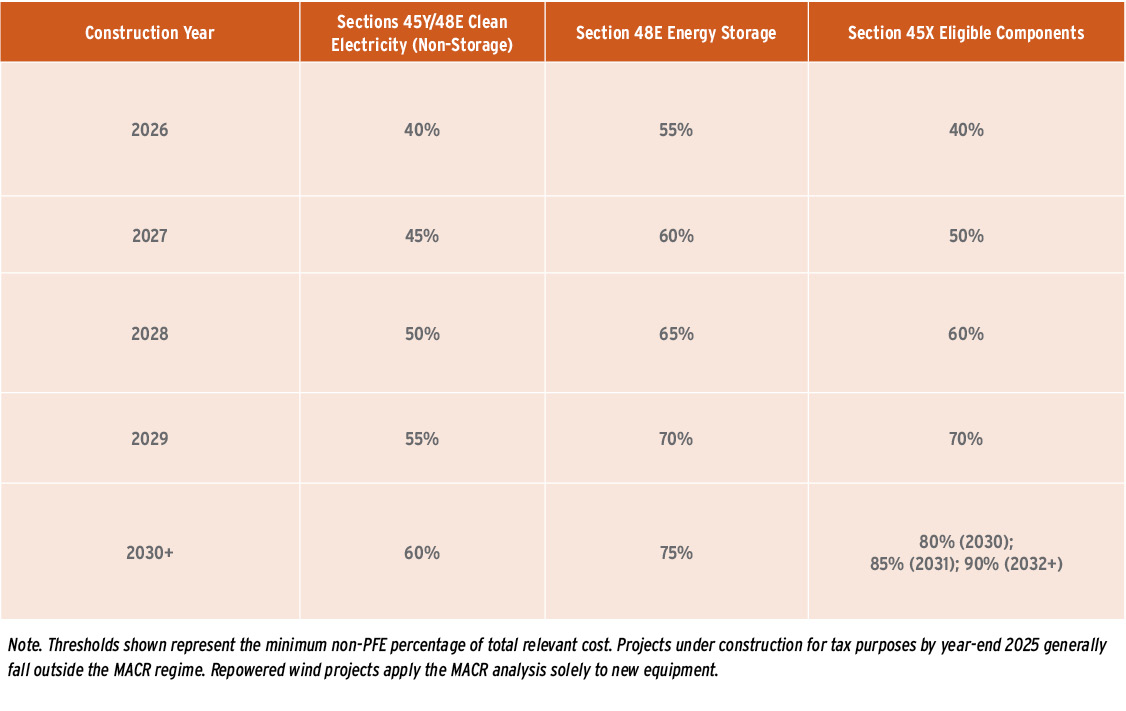
The applicable MACR thresholds increase over time and vary by credit type and asset class. Table 1 summarizes the statutory phase-in for projects and components for which construction begins in the indicated calendar year.
The thresholds are stringent and rising, and they create a binary outcome. A project whose non-PFE cost percentage falls just below the applicable minimum receives no credit at all, not a proportionally reduced one. That binary structure, combined with the rising thresholds, is what drives the level of diligence the market now applies to procurement and supply chain documentation.
Notice 2026-15: The Operational Framework
Notice 2026-15 is the first interpretive guidance under the FEOC framework. The notice expressly does not constitute comprehensive regulatory guidance and contemplates further development through additional notices or proposed regulations. Within that interim posture, however, it accomplishes three important things. It restates the statutory definitions. It establishes a workable methodology for calculating the MACR. And it introduces three safe harbors that materially reduce the diligence burden for many taxpayers.
MACR Calculation Mechanics
Section 3 of the notice establishes a structured five-step process for calculating the Clean Electricity MACR applicable to Sections 45Y and 48E, and a parallel framework for the Section 45X Eligible Component MACR. For Sections 45Y and 48E, the steps are as follows:
- Identify all manufactured products (MPs) incorporated into the qualified facility or energy storage technology and break them down into their relevant manufactured product components (MPCs). The level of detail required is substantially similar to the 2023–2025 safe harbor tables in Notices 2023-38, 2024-41, and 2025-08;
- Track the PFE status of each MP and MPC, documenting sourcing, manufacturer identity, and the entity-level analysis supporting the conclusion;
- Determine direct material costs either by reference to actual cost data or, where available, by reference to the adjusted cost percentages in the safe harbor tables;
- Compute the ratio of non-PFE cost to total cost; and
- Compare the resulting MACR to the applicable threshold for the project’s construction year.
One important mechanical clarification is the supplier-tax-year rule. In most cases, a supplier’s PFE status is determined as of the last day of the supplier’s tax year in which the cost was paid or incurred. Tying the determination to a fixed measurement date avoids the practical impossibility of perpetual ownership monitoring.
The Section 45X eligible component MACR follows an analogous structure but introduces an additional traceability layer through constituent materials. As discussed in the section “Transactional Implications,” this is where the Section 45X analysis materially diverges from Sections 45Y and 48E.
The Three Safe Harbors
Section 4 of Notice 2026-15 introduces three safe harbors that practitioners already rely on to make the calculation administrable.
The identification safe harbor permits a taxpayer to treat the components listed in the 2023–2025 safe harbor tables as the exclusive universe of MPs and MPCs for MACR purposes. It is the most consequential of the three safe harbors. It removes the obligation to chase every screw, bolt, and fastener and instead confines the inquiry to a defined list. In typical solar fact patterns, the higher-value items such as cells, modules, and inverters drive the answer. Substantiating non-PFE treatment of those items can carry a project most of the way to the applicable threshold.
The cost percentage safe harbor permits a taxpayer to use the adjusted cost percentages in the domestic content tables (most recently in Notice 2025-08) in lieu of actual cost data, but only for the types of projects for which tables exist. Where available, this safe harbor reduces the data-gathering burden, particularly for diligence in transferable credit transactions where actual cost data may not be readily shareable across counterparties.
Last, the certification safe harbor permits a taxpayer to rely on supplier certifications regarding PFE status and material assistance content, signed under penalties of perjury, with specified record retention requirements. Reliance is conditioned on the taxpayer’s not knowing or having reason to know that the certification was inaccurate, the much-discussed reason-to-know standard.
The three safe harbors are not mutually exclusive. A typical compliance file relies on the identification safe harbor to constrain the component universe, the cost percentage safe harbor (where available) to populate cost inputs, and the certification safe harbor to establish PFE status of suppliers. The combination is what makes the regime administrable. In isolation, each safe harbor addresses only a portion of the calculation burden.
The Reason-to-Know Standard
The certification safe harbor is the most discussed of the three because of its risk-shifting effect. The supplier signs under penalties of perjury, the taxpayer relies on the signed certificate, and the taxpayer is protected so long as it neither knew nor had reason to know the certification was inaccurate.
The notice does not define the contours of what constitutes a reason to know. Market practice is converging on a process-based interpretation. A signed certification is necessary but rarely sufficient. A defensible file typically also includes a supplier questionnaire, a high-level sourcing or supply chain map, and a basic sanity check against publicly available information about the supplier. The objective is to demonstrate that the taxpayer built and followed a reasonable process. The objective is not to prove a negative.
On a practical level, a single signed PDF in a deal file with no surrounding diligence record will be very difficult to defend on audit. Conversely, an overbuilt diligence record that purports to verify every constituent material may not be cost effective for many transactions and may not be necessary to support reliance. The art is locating the middle: structured, documented, and proportional to the risk profile of the project and the counterparty.
Areas of Unresolved Interpretive Risk
Notice 2026-15 makes significant progress on the MACR process but leaves several issues open to future guidance. The items below surface most frequently in current transaction work.
Effective Control and the Licensing-Agreement Gap
The effective-control provision in IRC Section 7701(a)(51) converts certain contractual arrangements with an SFE into PFE-triggering events. Congress has identified thirteen specific contract clauses as indicators of effective control. A separate rule provides that the grant or modification of a right to use SFE-owned intellectual property on or after July 4, 2025, is automatically deemed to convey effective control.
Notice 2026-15 confirmed the basic statutory framework but stopped short of defining what a licensing agreement is for these purposes or what scope of contract falls within the rule. That definitional gap has become one of the most pressing practical issues in the market. At the Infocast Tax Credits & Transferability conference in Houston on May 5, 2026, panelists from Foss & Company, CohnReznick, McGuireWoods, and Empact Technologies all flagged the licensing-agreement question as a material source of transactional uncertainty under Sections 45X, 45Y, and 48E. The concern is that under a literal reading of the statute, Treasury could sweep in virtually any contract attached to an energy project rather than focusing on contracts with direct implications for the credit-eligible asset.
The tax section of the New York State Bar Association (NYSBA) raised the same concern in a report issued April 30, 2026, observing that common features of energy project contracts, such as covenants not to sue and standard product warranties, could (on a broad reading) inadvertently trigger FIE status. Those are not exotic provisions. They appear in routine equipment supply, EPC (engineering, procurement, and construction), and offtake agreements. If the eventual regulations carry forward the broadest reading, otherwise unobjectionable project documentation could create an unexpected eligibility risk.
Until further guidance arrives, market practice is converging on a case-by-case review with counsel. In the contexts of Sections 45Y and 48E, intellectual property (IP) licensing has not yet emerged as a common transactional issue outside of supervisory control and data acquisition (SCADA) and embedded firmware arrangements, where a credible income-tax argument exists that the license is not a license at all. In Section 45X transactions, the issue is more acute. Manufacturing equipment for solar cells, modules, inverters, and battery components is largely robotic and frequently subject to operational software licenses from international vendors. Where the upstream licensor is, or may be, an SFE, those licenses can independently establish effective control over a manufacturing line, with consequences that extend through the Section 45X material assistance analysis.
The market posture in current Section 45X transactions has been to scrub existing contracts for the thirteen statutory clauses that identify effective control, locate any post–July 2025 IP licenses or modifications involving SFE counterparties, and either rewrite or amend the underlying license or build contractual protections when doing so is infeasible. Section 45Y and Section 48E transactions take a lighter approach, but the NYSBA’s concerns suggest that even those transactions may need a broader contract review than is currently typical.
The Section 48E Recapture Provision
An important but underdiscussed provision of the OBBBA is the Section 48E recapture rule. If a Section 48E investment tax credit (ITC) claimant makes a payment to an SFE that establishes effective control over the credited property within the ten-year period beginning on the placed-in-service date, the credit is recaptured. The recapture is structured as a 100 percent reduction of all prior Section 48E credits attributable to the property.
The provision is broadly worded, with onerous statutory processes. It applies to entities claiming credits in tax years beginning more than two years after the date of enactment of the OBBBA, which puts the operative effective date in tax year 2028 for many calendar-year taxpayers. The market has only just begun grappling with its scope and what mitigation looks like in practice. Investors and credit purchasers should begin exploring this risk in current diligence and structuring, even though the cliff date is still some quarters out.
Recapture Allocation for Fraudulent Certifications
Where a taxpayer relies in good faith on a supplier certification that is later shown to be false, the unresolved question is who bears the resulting credit-level consequence. The reasonable reading is that a taxpayer should be protected to the extent of its reliance under the certification safe harbor, with the supplier bearing penalty exposure based on the perjured certification. But the guidance does not yet clearly answer whether the result is credit recapture or disallowance, supplier-level penalties only, or some combination.
Until the question is resolved, market participants are addressing it through contract. Enhanced legal representations, indemnities (often uncapped for FEOC matters), and in some cases parent-level credit support behind the indemnifying party have become standard tools. Insurance, discussed below in “The State of FEOC Insurance,” is not yet a reliable backstop.
Corporate Group and Affiliate Taint
The statute provides limited explicit guidance on how PFE status within a broader corporate group affects affiliated entities, joint venture partners, and downstream project vehicles. The extent to which taint travels within controlled or related-party structures will continue to receive attention, particularly in restructuring contexts where pre-OBBBA arrangements are being rewritten or revised to avoid PFE classification. A preexisting loan from a former PRC-affiliated entity is not automatically cleansed by standing up a new affiliate. The historical relationship and the substance of the financing both remain relevant.
Transactional Implications
For corporate tax executives whose companies participate in the energy tax credit market, whether as investors, sponsors, transferees of credits under Section 6418, or counterparties to manufacturers, the FEOC framework is reshaping deal diligence, contractual risk allocation, and pricing. The remainder of this article focuses on those transactional dimensions.
Diligence Asymmetry Between Sections 45Y/48E and 45X
A practical point often missed at the outset of a transaction is the structural diligence asymmetry between credit types.
For Sections 45Y and 48E, the material assistance rules apply, but the supply chain analysis is a single-layer exercise. The taxpayer must identify the MPs and MPCs in the project, determine the PFE status of their suppliers, and compute the ratio. The entity-level PFE analysis applies to the project owner (the credit claimant) and to certain counterparties, but the scope is contained.
For Section 45X, the analysis has two layers. The Section 45X claimant must satisfy entity-
level PFE rules in its own right and must independently satisfy the material assistance rules with respect to the eligible component being produced. For a simple manufacturer with a limited bill of materials, this is manageable. For a large commodity mill with international supply chains, equipment licenses, and complex constituent-material sourcing, the analysis is genuinely difficult. The certification chain runs deep, often requiring sub-tier suppliers to provide their own certifications to support the manufacturer’s certification to the project.
Investors and credit purchasers should price this asymmetry into their diligence budgets. A Section 45X transaction typically requires more sophisticated counsel and a longer diligence runway than a comparably sized Section 48E transfer.
Tax Equity vs. Transferable Credit Diligence
The capital structure of a transaction materially affects the depth of FEOC diligence the market expects. In a traditional tax equity partnership, the investor is allocated the credits at the partnership level and bears direct recapture exposure across the credit’s compliance period. Tax equity diligence has historically been the most rigorous in the market, and identifying businesses as FEOCs has not changed that. If anything, doing so has reinforced the rigor of tax equity diligence. Tier-one tax equity investors are pushing developers to produce robust FEOC compliance packages well in advance of funding, with the diligence often extending to supplier-level documentation that would have been considered unusual two years ago.
In a Section 6418 credit transfer transaction, the seller retains primary credit-level recapture exposure but the transferee runs the risk that the credits it purchases are disallowed or recaptured. The market’s response has been to push for legal representations and indemnities that allocate FEOC risk to the seller, frequently with strict liability framing on PFE status and stronger indemnification language than the broader tax-credit recapture indemnity. Where the seller is a special-purpose project vehicle, transferees increasingly require a parent guarantee or other credit support behind the indemnity.
Lender diligence sits between these poles. A pure project-finance lender typically does not bear direct credit recapture risk but is exposed to underlying project economics, including the tax credit value embedded in the sponsor’s capital structure. Lenders generally rely on the diligence performed by the tax credit investor or transferee, with their own work focused on confirming that the FEOC analysis has been done and documented.
The State of FEOC Insurance
Tax credit insurance has become routine in the transferable credit market over the past several years, but FEOC coverage in particular remains cost-prohibitive and challenging to secure. The fundamental underwriting challenge is the binary nature of the PFE test. A PFE determination is total credit loss, not a partial impairment, and underwriters need strong work product, typically a well-reasoned legal opinion from respected counsel, to support a policy.
In current practice, FEOC risk is more commonly managed contractually than by insurance. Where coverage is available, it tends to be for counterparty PFE classification involving larger publicly traded sponsors with publicly disclosed ownership structures rather than for material assistance risk on Section 45X transactions or for effective-control questions where the underlying facts are less transparent. The market expectation is that coverage will broaden and premiums will decrease as the underlying compliance work product matures and as a second tranche of regulatory guidance reduces any residual interpretive risk.
Contractual Risk Allocation Mechanics
As noted above, in the absence of robust insurance, market participants are managing residual FEOC risk through contract. The mechanisms that have emerged (in approximate order of prevalence) are:
- strict legal representations from sellers and project owners regarding PFE status, the absence of effective-control arrangements, and the methodology used to calculate and substantiate the MACR. Representations are typically broad-based and survive past closing for the credit compliance period;
- robust indemnities, frequently uncapped for FEOC matters, against credit recapture and disallowance. In credit transfer transactions, the indemnity typically also covers gross-up for the transferee’s tax inefficiency;
- credit support, including parent guarantees or letters of credit, where the indemnifying counterparty is a thin special-purpose vehicle. This is becoming more common in Section 45X transactions where the manufacturer operates through a newly formed entity;
- pricing adjustments rather than holdbacks or escrows in most cases, with holdbacks reserved for fact patterns where a buyer wants to wait for further guidance before releasing the full purchase price; and
- ongoing compliance covenants, including obligations to maintain certifications and supply-chain documentation, to report changes in supplier composition, and in some cases to permit periodic audit of the underlying compliance file.
Supplier Certification Negotiation
Suppliers are pushing back on the certification safe harbor, which should not be surprising. Suppliers are being asked to sign under penalties of perjury, retain records for six years, and stand behind portions of their own supply chain that they may not fully control. Many are leaning in to remain competitive in the US market, but negotiation is occurring around specific points. These include the scope of the certification (what is being certified to what level of granularity), upstream disclosure obligations (whether the certifying supplier must identify its own sub-tier suppliers), and indemnification (who bears the consequence of a downstream certification failure).
Module manufacturers, for example, frequently agree to provide certifications regarding the modules themselves but resist disclosing the identities of their cell manufacturers. The reasons are partly competitive and partly defensive. The cell manufacturer typically has its own certification obligations upstream, and the module manufacturer prefers not to assume liability for facts it does not fully control. Resolution typically takes the form of a layered certification chain, in which each tier certifies what it knows and disclaims what it does not, with the project owner aggregating the resulting record.
Private equity–Owned Sponsors and the Limited partnership Look-Through Problem
A fact pattern that is increasingly common in the energy tax credit market deserves its own treatment. Many US clean energy sponsors are now owned, in whole or in significant part, by private equity infrastructure funds. From a credit-buyer perspective, these counterparties present a distinct set of challenges that the standard counterparty diligence playbook does not fully address.
The core problem is the Section 318 attribution analysis. To confirm that a private equity–owned sponsor is not an FIE, the buyer must satisfy itself that no single SFE owns twenty-five percent or more of the sponsor (looking through the fund) and that SFEs in the aggregate do not own forty percent or more. That requires insight into the limited partner composition of the fund itself. Private equity sponsors are typically unwilling to disclose detailed limited partner information, both for fund-confidentiality reasons and because the general partner may not always have complete real-time visibility into its own limited partner base after secondary transfers. Sovereign wealth funds, foreign pension funds, and offshore family offices are common limited partners in US infrastructure and energy funds, and any of them could carry SFE exposure that the sponsor itself cannot fully see through.
A second problem is risk allocation. The seller of the credits is typically a project-level special-purpose vehicle with no independent ability to satisfy a meaningful FEOC indemnity. Buyers naturally look up the ownership chain for credit support, but private equity sponsors are frequently unwilling to provide a fund-level guarantee of FEOC compliance. The commercial position is understandable. The private equity fund did not itself violate any rule, and a fund-level guarantee can create cross-portfolio exposure and complicate the fund’s own limited partner reporting. From the buyer’s perspective, however, the absence of meaningful credit support behind the indemnity materially changes the risk profile of the transaction.
Buyers facing this fact pattern have several options, none of them perfect. Counsel can negotiate for a sponsor representation at a defined level of knowledge, typically actual knowledge of any limited partner that would cross an SFE threshold, supported by reliance on the fund’s standard subscription documents and anti-money-laundering and know-your-customer procedures. A more protective approach is to require a fund-level guarantee of the project-company indemnity, which the sponsor will often resist but which is sometimes achievable in larger transactions or with repeat counterparties. Where neither is achievable, buyers should consider pricing the residual risk, requiring a holdback against the FEOC indemnity until after the seller’s first post-closing PFE recertification, or placing tax credit insurance specifically against the PFE classification exposure. The combination of measures should be calibrated to the size of the credit position and the buyer’s read on the credibility of the sponsor’s own limited partner–level diligence.
Practically, the question of whether to transact with a private equity–owned sponsor at all is increasingly a function of the sponsor’s willingness to engage on these issues. Sponsors that have invested in their own internal FEOC compliance infrastructure, including limited partner questionnaires, side-letter representations, and counsel-supported PFE classification analyses, are materially easier to underwrite than sponsors that treat the question as the buyer’s problem. Buyers should ask early in the process what the sponsor’s own stance on diligence is. The answer is often as informative as the formal compliance package that follows.
Building a Buyer-Side Diligence Program
For a corporate buyer of transferable energy tax credits, or for a tax equity investor evaluating an investment, FEOC compliance is not something to take on alone. The statutory framework is new, the guidance is interim, and the consequences of getting it wrong fall directly on the credit holder. The right move is to build a diligence program that combines internal governance with experienced outside counsel and qualified third-party advisors, with each playing a defined role in producing a documented, defensible compliance position before funding.
The core elements of a buyer-side program are as follows:
- Engage qualified tax counsel early. Tax counsel should be retained before signing a term sheet, not after, ideally counsel with specific FEOC experience rather than general energy tax practitioners. Counsel’s role is to interpret the statute and Notice 2026-15 against the facts of the specific transaction, draft the FEOC-related representations and indemnification provisions in the transfer or partnership documents, and ultimately deliver a written tax opinion. For most institutional buyers, a “should”-level opinion covering both the PFE classification of the seller and counterparties and the MACR position of the project is now standard. The opinion is also what tax credit insurers will need to see if coverage is being sought;
- Require an agreed-upon procedures (AUP) report on the MACR. The MACR calculation is fact-intensive, depends on supplier-level cost data, and is the area most likely to be challenged on audit. Buyers should require the seller to engage a national accounting firm to perform an AUP on the MACR calculation as a closing deliverable, with the buyer named as an intended recipient. A properly scoped AUP will test the identification methodology against the safe harbor tables, align the cost inputs with underlying supplier documentation, evaluate the supporting certifications, and recompute the resulting ratio. The AUP is not an opinion or an audit, but it does establish that an independent professional has tested the seller’s work product against defined procedures, which is meaningful both to underwriters and to a future IRS examiner;
- Perform counterparty PFE diligence. Independent diligence on the seller and on the project’s material counterparties (sponsors, manufacturers, key suppliers, and IP licensors) should be performed before funding. For publicly traded counterparties, the analysis can often be substantiated through public filings and a confirmatory representation. For privately held counterparties, buyers should expect to receive ownership charts, debt schedules, and beneficial ownership reporting documentation, and should have counsel apply the Section 318 attribution rules to confirm that no SFE threshold is crossed. Private equity–owned sponsors present a distinct set of challenges discussed in the section of this article titled “Private Equity–Owned Sponsors and the Limited Partnership Look-Through Problem.” Where the facts are close to a threshold under any scenario, a separate counsel opinion on PFE classification is appropriate;
- Develop MACR working files. Maintain a working file for each credit-eligible asset that captures the identification methodology, cost inputs, supplier certifications, and the resulting MACR calculation. The working file is what auditors and transferees will request. Building it contemporaneously is materially cheaper than reconstructing it after the fact; and
- Include governance hooks. Embed FEOC questions into existing transaction approval workflows, vendor onboarding processes, and post-closing monitoring. PFE status is determined annually. Maintaining compliance cannot be a one-time exercise.
Conclusion
For tax executives, the operational takeaway is that eligibility for Section 45Y, Section 48E, and Section 45X credits now turns on entity-level facts (PFE status), product-level facts (the MACR), and contractual facts (effective control). All three must be diligenced and documented across what is often a multitiered supply chain. IRS Notice 2026-15 provides workable mechanisms for the MACR and three real safe harbors that materially reduce the calculation burden, but it leaves the broader PFE definitions and the effective-control rules, including the scope of the licensing-agreement provision, for additional guidance.
Market practice is converging on a risk-managed, fact-based approach: structured diligence, careful contractual scrubbing, robust certification processes, and conservative documentation pending further regulatory clarity. Few in-house tax functions are equipped to run this analysis alone, and the better-resourced buyers in the current market are routinely combining qualified counsel, accounting firm AUP work, and experienced transactional intermediaries to build defensible compliance positions before funding. For the in-house tax function, the FEOC framework is best treated not as a one-time eligibility test but as an ongoing governance discipline embedded in transaction structuring and ongoing asset management. Companies that build that discipline now, with the right outside partners, will be well positioned as guidance evolves. Companies that wait will find themselves making rushed corrections under credit recapture exposure that is harder and more expensive to unwind.
The regime is interim, the guidance is evolving, and the stakes (credit eligibility, ability to finance, and recapture exposure) are large enough to warrant treating FEOC compliance as a first-order risk on every new transaction. Notice 2026-15 is the first real step toward an administrable framework. It is not the last word, but it is the framework the market will operate within for at least the next several quarters, and it deserves to be reflected in every transaction document, diligence checklist, and compliance protocol that touches a federal energy tax credit.
Bryen Alperin is a partner and managing director at Foss & Company.

Disclaimer: This article reflects the FEOC framework and the interim guidance in IRS Notice 2026-15 as of the date of publication. It is provided for general informational purposes only and does not constitute, and should not be construed as, investment, legal, regulatory, or tax advice. Readers are solely responsible for their own decisions and the application of these rules to specific facts and circumstances and are strongly encouraged to seek independent advice from their tax advisors, legal counsel, and applicable domiciliary regulators before making any investment, structuring, or legal determinations.