



Tariffs are forcing rapid changes to intercompany pricing, often under significant time pressure. Most global trade is intrafirm, and, in many cases, tax teams are asked to restore margins or reduce duty exposure using familiar transfer pricing tools. Those changes may be defensible for income tax purposes, but they can create a different set of risks under customs law—risks that are often not identified until well after the pricing change is implemented.
This article focuses on where those approaches can break down and why coordination between the tax and trade functions is critical before changes are made.
Framing the Problem
A Hypothetical
Nuri is a Korean electronics company that designs, manufactures, and sells mid-market smartphones worldwide. Its products include a popular foldable device that retails in the United States for $600. Product margins are low, because the US market is intensely competitive at this price point. Nuri cannot raise the retail price, or it will risk losing sales volume and market share. It manufactures the devices through a contract manufacturer in China, Jingwei, and sells the finished phones in the US market through its wholly owned distributor, Nuri US.
Jingwei manufactures the devices using Nuri’s designs and intellectual property. Nuri sells the finished devices to Nuri US, a limited risk distributor that should earn a target three percent operating margin on its sales to unrelated US retailers. The resulting per-unit economics are as follows:
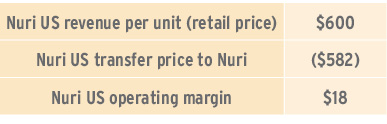
Now assume that the United States has imposed a ten percent tariff on smartphones originating in China as the place of manufacture. Nuri US is the importer of record and declares the customs value of the imported devices based on the $582 intercompany-invoice price. The tariff fundamentally changes the per-unit economics:
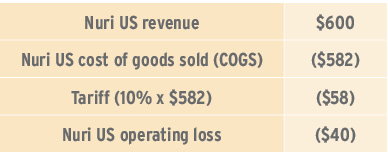
Because Nuri cannot pass the tariff costs on to its customers, it has to absorb them elsewhere in the supply chain. The CEO calls an emergency meeting and directs the tax department to do whatever it takes to modify the existing transfer pricing policy to minimize the tariff and restore Nuri US to profitability.
The Tax Team’s Plan
The tax team identifies two levers to mitigate the US tariff. First, it introduces a new five percent marketing royalty to compensate Nuri for a global marketing campaign related to a “golden” version of the device released in conjunction with a hit movie. Second, the tax team increases the target operating margin of Nuri US to nine percent, which is at the top of the interquartile range. Nuri US would pay a reduced transfer price per device and a separate royalty that it believes is not dutiable, leading to the following result:
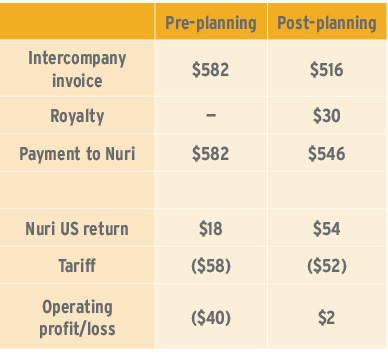
Although the net economic effect of this change will depend on the company’s broader tax profile (including relative US and Korean income tax rates, loss positions, and the treatment of royalties and tariffs for income tax purposes), we set those considerations aside here. The point is not that the strategy is economically optimal, but rather that it reflects how companies often adjust their transfer pricing to respond to tariff exposure.
The tax team is satisfied: Nuri US is again profitable, and the modified prices fall within defensible transfer pricing parameters. They do not confer with trade compliance colleagues or advisors because, on their face, the changes appear commercially sensible.
Different Regimes, Different Perspectives
Transfer pricing and customs valuation operate under different frameworks with distinct objectives and methodologies. Transfer pricing generally tests whether an entity’s aggregate annual results fall within an acceptable arm’s-length range, regardless of whether particular components are dutiable. Customs valuation starts with the transaction value for a particular dutiable transaction at the time of importation and includes a “reconciliation” process that extends up to twenty-one months afterward. In the related-party setting, US Customs and Border Protection (CBP) will examine the circumstances of the sale to determine whether the parties’ relationship influenced the price actually paid.
In its analysis CBP may leverage transfer pricing documentation as a starting point and a source of relevant information. Tax results are not determinative even when the pricing is governed by an advance pricing agreement with the Internal Revenue Service. Moreover, pricing changes that ostensibly reduce the dutiable value—like the royalty disaggregation in the Nuri hypothetical—can raise new questions about whether the royalty should itself be included in dutiable value. Under 19 USC Section 1401a(b)(1)(D), for example, a royalty that the buyer pays as a condition of the sale of the imported merchandise is added to the transaction value, regardless of how the payment is characterized for tax purposes. CBP could also scrutinize the invoice-price reduction attributable to the increased distribution return and assert that the parties’ relationship (and not the market) drove down the price.
Trade Compliance Issues to Consider
The valuation questions identified above carry enforcement consequences well beyond a routine disagreement with CBP. CBP has recognized in Ruling HQ W548314 that written transfer pricing policies may, in some circumstances, support adjustments to customs value—but only where the policy, inter alia, predates importation, is reflected consistently in tax reporting and accounting records, and is tied to a preexisting formula. In the Nuri hypothetical, where the pricing change during reconciliation is adopted in direct response to a new tariff, that showing becomes significantly more difficult. Given that the enforcement backdrop is now materially more aggressive, such a shift would likely face heightened scrutiny from CBP.
The principal civil customs penalty, Section 592 of the Tariff Act of 1930 (19 USC Section 1592), prohibits the entry or attempted entry of merchandise by means of a materially false statement, act, or omission. Penalties escalate quickly: negligence can reach two times the lawful duties lost, gross negligence four times, and fraud the domestic value of the merchandise. Critically, negligence and gross negligence do not require proof of intent. A company therefore can face significant exposure even if it believed the revised value was supportable under transfer pricing rules. An important safety valve exists: a valid prior disclosure under 19 CFR Section 162.74 allows importers to voluntarily disclose violations to CBP before or without knowledge of a formal investigation and substantially reduce potential penalties. But the practical point remains: a tariff-driven pricing change is not just a predicate to a later valuation discussion with a port auditor. If the customs narrative is weak, the downside includes additional duties, penalties, and even seizure risk (that is, forfeiture of the imported merchandise entirely).
Nor is the customs risk confined to CBP’s administrative process. In August 2025, the Department of Justice and the Department of Homeland Security launched a joint Trade Fraud Task Force expressly aimed at tariff and duty evasion, deploying civil, criminal, and administrative customs tools in parallel. The DOJ then identified tariff and customs-duty evasion as an enforcement priority in its January 2026 False Claims Act report. Recent matters illustrate the scale of that exposure: a $54.4 million customs-duty settlement against Ceratizit USA and a whistleblower-driven action resulting in a $12.4 million recovery against Allied Stone, Inc.
The False Claims Act, 31 USC Sections 3729–3733, is especially potent in the customs context because it authorizes qui tam (whistleblower) suits by private “relators”—often current or former employees or competitors—who may share in any recovery, and it allows the government to recover up to three times its actual damages plus civil penalties for each customs entry filed at a misstated value. Where the government believes duties were evaded willfully, it can also pursue criminal charges under 18 USC Section 542, which prohibits the entry of goods by means of false statements. Criminal customs prosecutions remain relatively rare, but they are more likely where internal documents suggest the company knew the declared values or origin claims were not supportable—the kind of paper trail that can exist when pricing changes are implemented without trade-counsel coordination.
The timing mismatch compounds all of this. Pricing changes are made today, but the customs audit or qui tam complaint may not arise until years later—after entries have liquidated, employees have moved on, and the company is left trying to reconcile tax files, customs declarations, and intercompany agreements that no longer tell a consistent story. That is precisely why contemporaneous documentation matters: importers should preserve the records supporting pricing changes, including relevant customs records, for at least five years, as 19 USC Section 1508 requires. Divergent outcomes across regimes can also create cross-border problems. For example, if CBP in a final determination rejects the lower import value and asserts additional duties, there is no offsetting mechanism or treaty-based procedure by which the company can recover the customs cost imposed by a foreign authority on the same transaction. The company may end up paying full duties and income tax on that transaction, with no path to further relief in either forum.
The Coordination Problem
The core challenge is that companies have competing incentives for customs and income tax. For customs, a lower transaction value means lower duties. For income tax, that means a lower cost of goods sold (COGS) and increased US taxable income. Solving one problem can exacerbate the other. Internal Revenue Code Section 1059A can sometimes compound the problem on the tax side by limiting deductible inventory cost to the amount of the same costs taken into account in determining customs value, meaning that if the trade group were to successfully argue for a lower customs value, such as by changing the customs valuation method, it may find itself stuck with that same low cost basis for tax purposes.
Section 1059A aside, no general harmonization mechanism exists now for companies to coordinate outcomes between CBP and the IRS. But there is limited information sharing, and we know the IRS has started sharing information with CBP, albeit on a limited, case-by-case basis. The reverse may also be true. Inside companies, the customs and tax functions are often siloed, mirroring the government’s own structural separation, but that symmetry serves only the government, not taxpayers.
What In-House Tax Teams Should Do
Tax teams should work in tandem with their trade colleagues (both in-house and external advisors) to recognize when a tariff issue is not just a pricing problem. Both disciplines should rigorously pressure-test any planning ideas, particularly before making corrections through the reconciliation process. They should also assess whether a new position—especially one that materially departs from prior positions—creates undue risk for historical positions taken in years subject to IRS and CBP adjustment. Where tariffs apply only to a subset of products, they should consider the broader pricing impact on similar products.
Documentation should be a priority. Tax and customs documentation, including transfer pricing documentation, customs declarations, entry data, and supporting narratives should present a consistent, coherent narrative explaining why changes are occurring. Ensuring that the business rationale, tax analysis, and customs narrative all tell the same story is critical.
For forward-looking certainty, companies can seek prospective CBP rulings on valuation, origin, and/or royalty treatment where the facts are stable. They do not provide comfort in cases of inconsistent historical positions, however. Given the fluid tariff environment, a more effective forward-looking strategy is to build flexible adjustment clauses into intercompany agreements so that pricing can shift in response to tariffs without requiring new agreements. Before finalizing and implementing, they should also consider tax consequences (such as those in Section 1059A), because customs savings that lead to comparatively greater taxes are a net negative.
Conclusion
Tariffs and transfer pricing pull in different directions. In the current environment, where tariff costs hit immediately, the instinct is to leverage transfer pricing as a quick fix. But that instinct can backfire in the long run. A pricing change that works for tax purposes can create serious problems on the customs side that might not surface for years.
Tax professionals need not master customs laws. But they must recognize that they are not solving a tax problem if tariffs are driving the analysis. In this environment, coordination is a risk-management imperative. When the urge is to speed up, tax professionals should instead slow down, involve the right people, and make sure their positions hang together across both regimes.
Saul Mezei is a partner in Gibson Dunn’s Washington, D.C., office and a member of the firm’s global tax controversy and litigation practice group. Adam Smith is a partner in Gibson Dunn’s Washington, D.C., office and co-chair of the firm’s international trade advisory and enforcement group.